



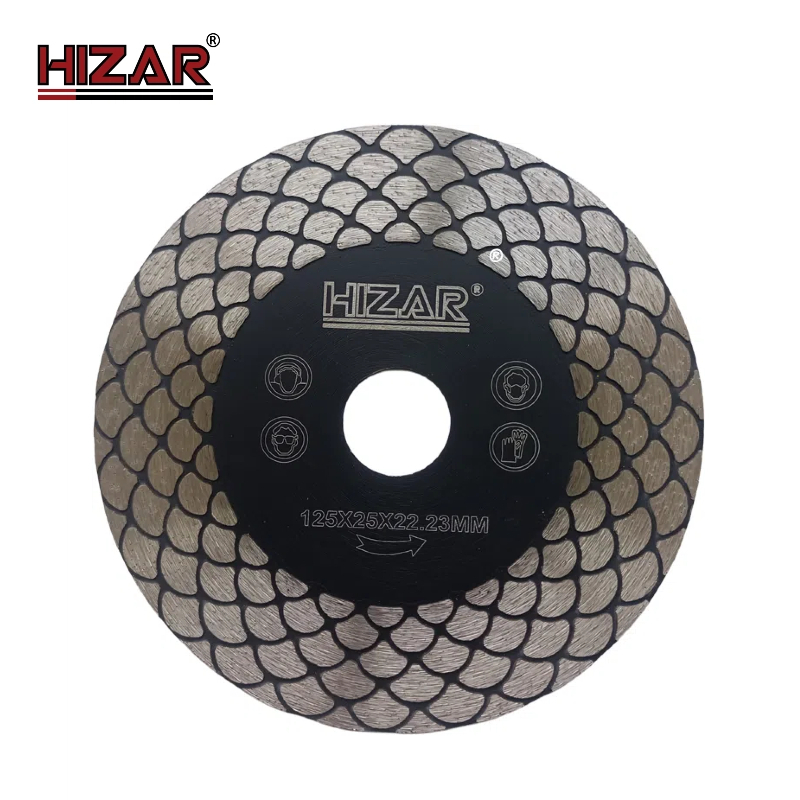
HCGMS Sintered Saw Blades
| Parameter | Common Options | Description |
|---|---|---|
| Diameter | 4", 4.5", 5", 6", 7" | Determines maximum cutting depth. Smaller diameters offer better control for detailed work. |
| Arbor Hole | 5/8"-11 (for angle grinders), 20mm, 1" | Must match the tool's spindle. 5/8"-11 is the standard for most angle grinders. |
| Rim Type | Continuous Rim, Turbo Rim, Segmented | Defines cutting speed, finish, and primary use case (see below). |
| Material | Diamond Grit (with metal powder bond) | The quality and size of the diamond crystals determine longevity and cutting speed. |
| Bond Hardness | Soft, Medium, Hard | A softer bond wears faster, exposing new diamonds for cutting harder materials. A hard bond lasts longer but is for softer materials. |
| Max RPM | ~12,000 RPM (for 4" blade) |
Never exceed the maximum RPM rating stamped on the blade.
|
2. Rim Types: Choosing the Right One for the Job
-
Continuous Rim (Smooth Rim)
-
Best For: Porcelain tile, ceramic tile, marble, and other delicate materials.
-
Advantage: Provides a chip-free, clean finish. Cools effectively.
-
Disadvantage: Slowest cutting speed.
-
Use Case: Wet or dry cutting.
-
-
Turbo Rim (Serrated Rim with Vents)
-
Best For: Granite, natural stone, concrete pavers, brick.
-
Advantage: Fast cutting speed. The turbo segments and vents improve airflow and cooling.
-
Disadvantage: Finish is not as clean as a continuous rim.
-
Use Case: Primarily dry cutting, but can be used wet.
-
-
Segmented Rim (With Gullets)
-
Best For: Aggressive cutting of concrete, block, brick, and hard stone.
-
Advantage: Most aggressive and durable. The segments dissipate heat efficiently.
-
Disadvantage: Very rough cut; will chip delicate materials.
-
Use Case: Dry cutting only.
-
3. Material Compatibility Guide
-
Porcelain & Ceramic Tile: Continuous Rim blade. A "porcelain blade" is specifically engineered for ultra-hard, glazed surfaces.
-
Marble & Slate: Continuous Rim or Turbo Rim for a balance of speed and finish.
-
Granite & Engineered Quartz: Turbo Rim blade is the standard choice for speed and durability.
-
Concrete Pavers & Brick: Turbo Rim or Segmented Rim, depending on the required finish and speed.
-
Concrete Block & Rebar: Segmented Rim blade.
4. Pro Tips for Selection & Usage
-
Match the Blade to the Material: Using a segmented blade on tile will destroy it. Using a continuous rim blade on concrete will glaze it over and make it ineffective.
-
Wet vs. Dry: Wet cutting extends blade life, reduces dust, and provides a cleaner cut. Always check if the blade is rated for wet use.
-
Let the Blade Do the Work: Do not force the blade. Applying excessive pressure can overheat the blade and damage the diamond matrix.
-
Safety First: Always wear safety glasses, a respirator (for silica dust), and gloves. Use a tool with a proper guard.
5. Common Pitfalls to Avoid
-
Using a Blunt Blade: A blade that smokes, cuts slowly, or chips the material needs to be replaced or may be wrong for the job.
-
Incorrect Arbor Size: Using a blade without the correct bushing adapter can be extremely dangerous.
-
Overheating: Allow the blade to cool down during prolonged dry cutting to prevent the metal bond from losing its temper and diamonds from falling out.
Product description
Saw blade
Diamond saw blade is composed of a cutter body and a cutter head. Diamond saw blade is widely used in stone cutting machine to cutting different sizes and all kinds of stones, such as: granite, marble, porcelain, ceramic, glass, tile and so on. Little gap between the teeth guarantee a faster speed.
TECHNICAL PARAMETER
By size classification
| Product name | Saw blade diameter | Hole diameter | Segmenth height | Hot sale part no. |
| Small saw blade | 65-250mm | 20,22,23 mm | 7,8,10 mm | Protective-tooth(HDKPT1) |
| Medium saw blade | 300-800mm | 50,60 mm | 10,12,15 mm | Standard Type (HDGS) |
| Large saw blade | 900-3500mm |
| By the type of the stone classification | ||
| Application | Bonding method | Hot sale part no. |
| Granite | Sintering(Cold/hot pressed) | Turbo broad(HDKTL) |
| Marble | Vacuum brazed | Continous(HDVC) |
| ELectroplated | Starred(HDES1) | |
| Quartz | Sintering | K type(HDKK) |
| Ceramic | Sintering | Turbo super(HDKTS) |
| Concrete | Laser welding | Lateral protective teeth type(HDCSL) |
| Asphalt | Laser welding | Lateral protective teeth type(HDASL) |
| Sandstone | Laser welding | Sandstone saw blade(HDSS) |
Production process
For more than 40 years, she has grown and developed into one of the earliest and most professional stone machinery and diamond tools manufacturers and suppliers in China.
warehouse
Company profile
Suzhou Hizar Machinery & Tool Co.Ltd
Headquartered in Suzhou which is also known as " saw blade town of China" and "back yard of Shanghai" and boasts her long history and dynamic economy, .Hizar Group has now become one of the leading players in stone industry,covering manufacturing and sales of stone machines and diamond tools and equipment for making diamond tools ; equipments and tools for geological driling and mining exploration ,stone mining, importation and exportation of natural & artificial stones, kitchen & sanitary wares etc.
-- CONTACT HIZAR!
 Contact: Minna Shu
 Tel/Fax: 0086 512 66722996
 Email: info@chinahizar.com
 Mobile:
 0086 181 181 0809 9 (Diamond tool-Mr. Ye)
0086 18168 181696 (Machinery--Mrs. Shu)
 Headquarter: 3801#, Golden River Plaza, 35# Rd Shishan, SND, Suzhou, 215011, China. Factory: 15#Rd Fujin, Wuzhong District, Suzhou, 215100, China.